Material Selection and Vacuum Quenching for Long-Life Machine Tool Spindle Shafts
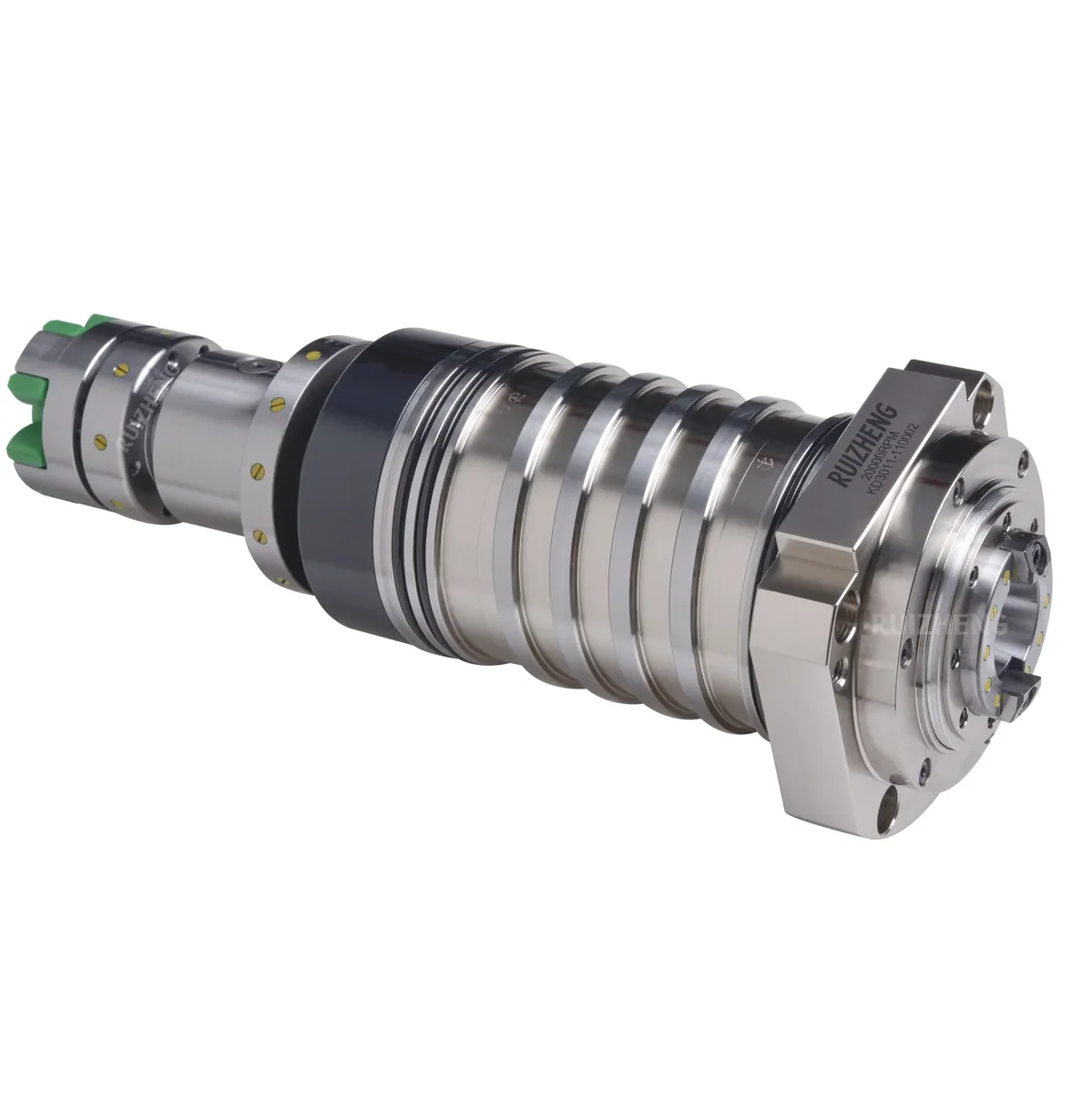
When you're specifying a custom spindle shaft for a machine tool, the material and heat treatment decide whether it survives 20,000 hours or fails in six months. This guide walks through the metallurgical trade-offs—core hardness, case depth, dimensional stability—and explains why vacuum quenching belongs in your process chain. Every tolerance and capability cited here comes from Foshan Ruizheng Machinery Manufacturing Co., Ltd., an ISO 9001:2015 certified shop in Foshan, China, with 70+ CNC and grinding machines, a German ZEISS CMM at 0.5 μm, and a constant-temperature workshop.
What a spindle shaft actually demands from its material
A spindle shaft isn't just a rotating cylinder. It carries bending loads from cutting forces, torsional loads from the drive, and thermal gradients from bearing friction. The material has to resist fatigue, wear at the bearing seats, and distortion during heat treatment.
Three properties matter most:
- Core toughness to absorb shock loads without cracking.
- Surface hardness at bearing journals and taper contacts to resist wear and fretting.
- Dimensional stability after machining so that final grinding holds concentricity to 0.001 mm.
Get the balance wrong and you'll see runout drift, chatter marks, or premature bearing failure. The material choice sets the ceiling on what heat treatment can achieve.
Material selection: alloy steel, bearing steel, and stainless options
Most spindle shafts fall into three material families. Each has a distinct role.
Alloy steel (e.g., 4140/42CrMo, 4340) is the workhorse. It offers good through-hardening response, decent machinability in the annealed state, and enough toughness after quenching and tempering. For a custom spindle shaft that sees moderate speeds and loads, alloy steel with a nitrided case often hits the sweet spot.
Bearing steel (e.g., 52100/GCr15) is chosen when you need extreme surface hardness and fatigue resistance at the bearing seats. It's less forgiving in heat treatment—distortion risk is higher—but vacuum quenching tames that. Ceramic bearing steel variants are also available for hybrid ceramic bearing applications.
Stainless steel (e.g., 17-4PH, 440C) enters the picture for corrosion resistance—think coolant-rich environments or medical/lab spindles. Precipitation-hardening grades like 17-4PH give a good compromise: you can age-harden to around 40 HRC without the distortion of a full quench.
Titanium alloy is available for special cases where weight reduction outweighs cost. It's not a default; it's a deliberate choice for high-speed or low-inertia designs.
Vacuum quenching: why it beats atmosphere or salt bath for spindle shafts
Vacuum quenching heats the part in a low-pressure environment and quenches with high-pressure gas (usually nitrogen or argon). The absence of oxygen means no decarburization, no oxidation, and no scale. For a precision spindle shaft, that's huge—you can often eliminate post-quench cleaning and reduce grinding stock.
More importantly, vacuum furnaces heat uniformly. Uniform heating translates to uniform austenitization, which means predictable, repeatable hardness and minimal distortion. When you're holding concentricity to 0.001 mm, distortion is the enemy. Vacuum quenching keeps it in check.
Compare the options:
| Process | Distortion risk | Surface quality | Repeatability | Best for |
|---|---|---|---|---|
| Vacuum quenching | Low | Bright, no decarb | High | Precision spindle shafts, bearing steel |
| Atmosphere quenching | Moderate | Some scaling possible | Moderate | General shafts, lower precision |
| Salt bath quenching | Moderate to high | Clean but risky | Moderate | High-hardness, simple geometries |
| Induction hardening | Low (localized) | Good, localized | High | Selective surface hardening on journals |
Vacuum quenching is the default for long-life spindle shafts because it protects the geometry you've already machined. If you're sourcing a spring machine spindle that runs at high cyclic rates, vacuum quenching plus stress relief is a proven route to fatigue life.
Heat treatment sequence: from stress relief to final grind
The order of operations matters as much as the process itself. A typical sequence for a hardened spindle shaft:
- Rough machining (leave grinding stock).
- Stress relief annealing to remove machining stresses before quenching.
- Vacuum quenching and tempering to achieve core hardness (often 28–32 HRC for alloy steel, or higher for bearing steel).
- Semi-finish grinding to establish geometry.
- Nitriding or induction hardening if a hard case is needed (case depth per design).
- Final grinding and super-finishing to hit ±0.002 mm and Ra 0.1.
- Stress relief (stabilization) after grinding if the part is critical.
Each step must be validated. At Ruizheng, the constant-temperature workshop and ZEISS CMM allow us to measure runout, concentricity, and roundness after each critical operation. You can read more about our grinding and QC process.
How vacuum quenching interacts with tight tolerances
Suppose you're aiming for 0.001 mm concentricity on a spindle shaft with bearing seats at both ends. If the quench distorts the shaft by even 5 μm, you'll struggle to grind it true without removing too much case depth.
Vacuum quenching minimizes that distortion through uniform heating and controlled gas quenching. The result: less grinding stock, shorter cycle times, and a more consistent final part. It's not magic—you still need proper fixture design and tempering—but it gives you a predictable starting point.
For spindle sleeves and bushings that mate with the shaft, the same logic applies. A spindle sleeve and bushing pair must maintain clearance under thermal growth; vacuum-quenched bearing steel sleeves hold their roundness to 0.001 mm, which keeps the fit stable.
Common pitfalls and how to avoid them
Even with good processes, mistakes happen. Here are the ones we see most often:
- Insufficient stress relief before quenching. Machining stresses release during heating, causing warpage. Always stress-relieve after rough machining.
- Over-hardening the core. A core that's too hard is brittle. Temper to a toughness that suits the application.
- Ignoring case depth on nitrided parts. Too thin a case wears through; too thick a case can spall. Specify case depth based on load and contact stress.
- Grinding burns. Aggressive grinding can temper the surface and reduce hardness. Use sharp wheels, adequate coolant, and light passes.
Each of these is controllable with a documented process and in-process inspection. Ruizheng's quality system includes 100% full inspection of critical dimensions, plus options for online video inspection and third-party verification.
Frequently asked questions
What's the difference between vacuum quenching and nitriding?
Vacuum quenching hardens the entire part (through-hardening) by heating to austenitizing temperature and quenching. Nitriding is a surface treatment that diffuses nitrogen into the surface at lower temperatures, creating a hard case without a quench. They're often used together: quench and temper for core properties, then nitride for wear resistance.
Can you achieve Ra 0.1 on a vacuum-quenched spindle shaft?
Yes. Vacuum quenching leaves a clean surface, and subsequent precision grinding and super-finishing can reach Ra 0.1. Ruizheng's grinding cells, including Taiwan imported centerless grinders and CNC cylindrical grinders, are set up for this.
How do you verify concentricity after heat treatment?
We use a ZEISS CMM with 0.5 μm accuracy and Mitutoyo roundness testers in a constant-temperature inspection room. Critical dimensions are 100% inspected, and we can provide inspection reports with the shipment.
Choosing the right material and heat treatment for a custom spindle shaft is a metallurgical balancing act. Vacuum quenching gives you the control you need to hold tolerances and extend life. If you're designing a spindle for a spring machine, a machining center, or any high-cycle application, start with the material and work backward through the process chain. Ruizheng's engineering team can help you validate the route—from raw material certification to final grind.
Need a Drawing Review or Sample Quote?
Manufactured directly by Foshan Ruizheng Machinery Manufacturing Co., Ltd. in our ISO 9001:2015 certified, temperature-controlled Foshan, China facility with 70+ CNC turning, milling, and grinding machines and German ZEISS CMM inspection.
Send 2D/3D Drawings for Quote